Science
First Stars, First Galaxies, SMBH
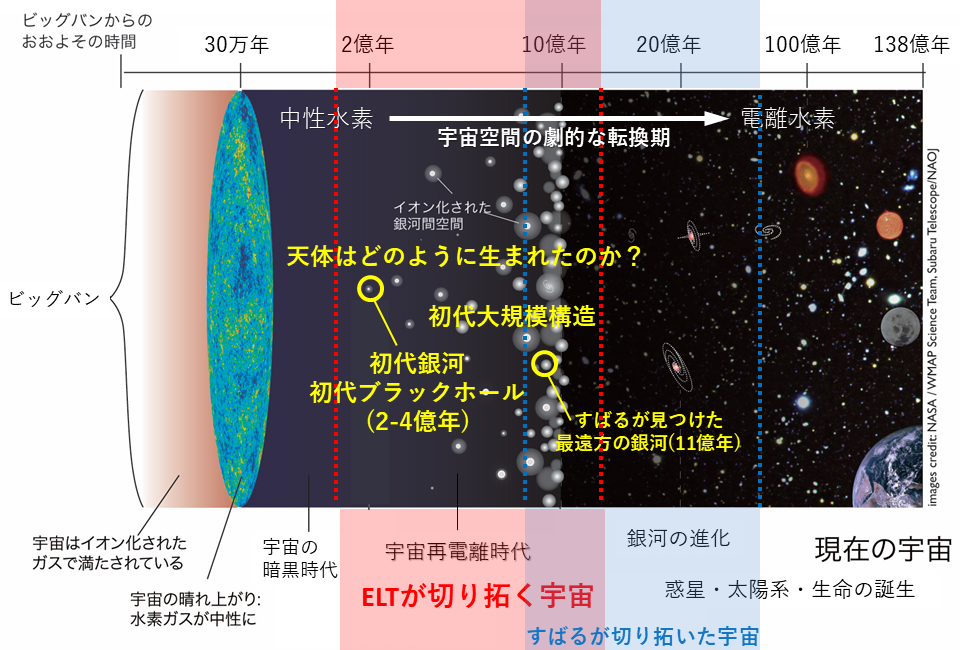
The first stars in the universe are thought to have formed about 100 million years after the Big Bang, followed by the formation of the first galaxies and supermassive black holes. The formation of these objects in the early universe is an important process that promotes the most ionization of the universe and lays the foundation of the current universe. Therefore, we are studying the formation of the first stars, the first galaxies, and supermassive black holes from both theoretical and observational viewpoints to understand how they formed.
As part of our theoretical research, we perform various fluid simulations mainly using supercomputers. We are investigating the processes from the mass accumulation of baryons and dark matter to the formation of primary galaxies by performing cosmological structure formation simulations that take into account feedback effects such as supernova explosions and active galactic nuclei. Based on the simulation results, the formation frequency and properties of primary galaxies and the possibility of future observations are discussed. In addition, high-resolution zoom-in simulations are performed to understand the mass growth process of individual stars and black holes that make up the first galaxies. By understanding the mass distribution of primary stars and the growth rate of black holes left behind after their death, we are trying to clarify the formation process of the first supermassive black holes in the universe.
On the other hand, the formation of galaxies and supermassive black holes in the deeper Universe are currently being discussed by JWST based on the results of Subaru Telescope and HST. The ELT is expected to reveal the detailed inner structure of distant galaxies with its high light-gathering power and high spatial resolution by adaptive optics. The ELT is expected to reveal the detailed inner structure of distant galaxies. We are making the best preparation for the ELT era to make the exploration of the distant universe more fruitful in the framework of the International Leading Astronomical Consortium, in which there is no boundary between theory and observation.
Galaxy Formation, Protoclusters
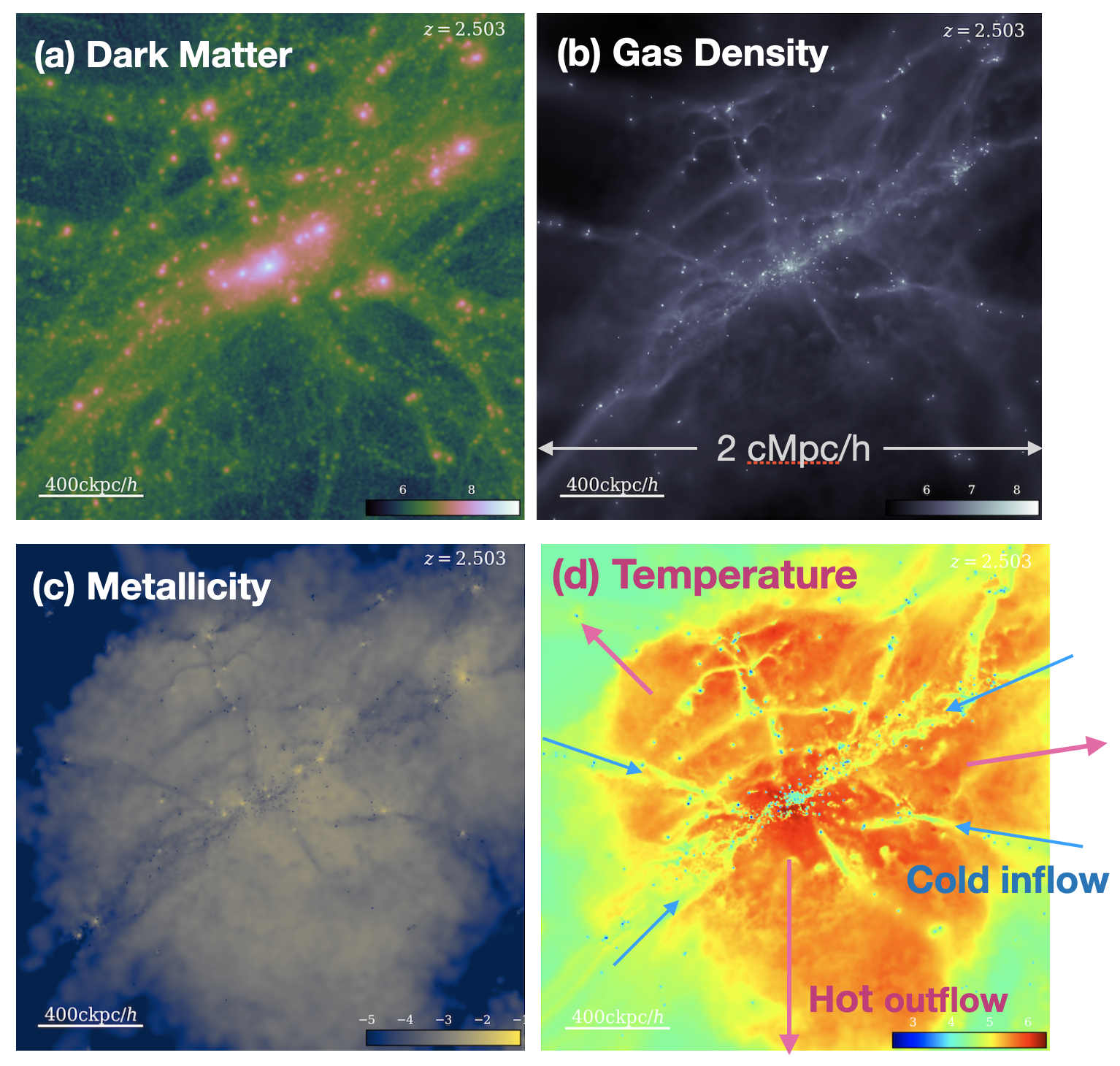
As cosmic structure formation progresses, galaxies grow, and the universe reaches the peak of its star formation activity about 3 billion years after the Big Bang. Around this time, protoclusters—the precursors of present-day galaxy clusters—also begin to form. These regions exhibit particularly active star formation compared to their surroundings and are therefore key environments for understanding galaxy formation.
On the theoretical side, we investigate the formation of protoclusters using cosmological structure formation simulations performed on supercomputers. Because protoclusters are rare, high-density regions, we employ zoom-in simulations that combine large cosmological volumes with high resolution in selected regions. By incorporating feedback processes and the physics of supermassive black holes, these simulations aim to clarify star formation activity in protoclusters, along with associated chemical enrichment, black hole growth, and active galactic nucleus (AGN) feedback.
On the observational side, we use multiwavelength data from facilities such as the Subaru Telescope and ALMA to study how galaxy populations, cold gas, and AGN are distributed within large-scale filamentary structures that include protoclusters, and where star formation is enhanced. These observations show that galaxy growth and star formation are intensified both in protocluster cores and in the filaments connected to them. We have also identified AGN that are likely in the growth phase of supermassive black holes destined to reside at the centers of future galaxy clusters.
By advancing protocluster studies through both theory and observation, this work provides important guidance for future observations of distant protoclusters with JWST and ELT. Through these efforts, we aim to achieve a unified understanding of how gas supply, star formation, and black hole growth are interconnected in protoclusters.
Cluster of galaxies and the large-scale structure of the Universe
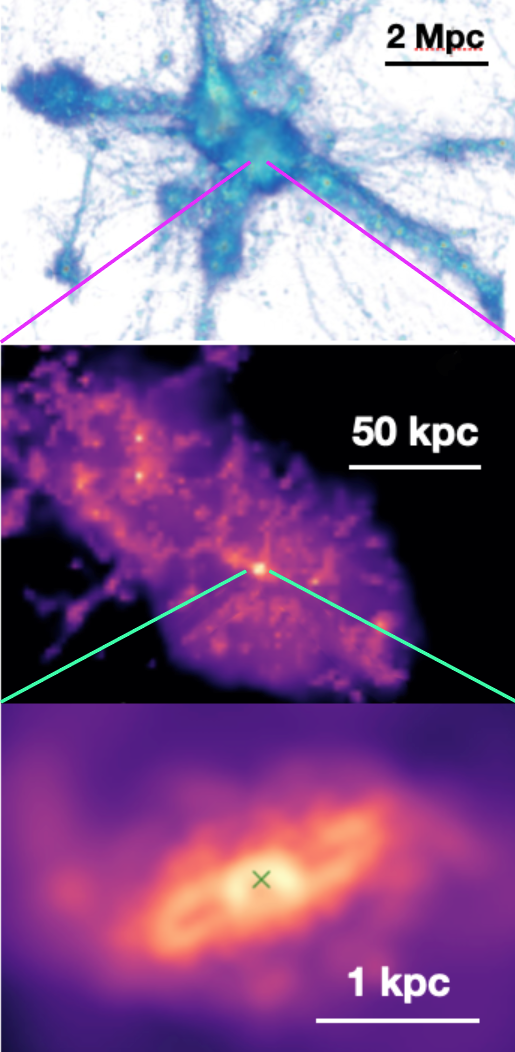
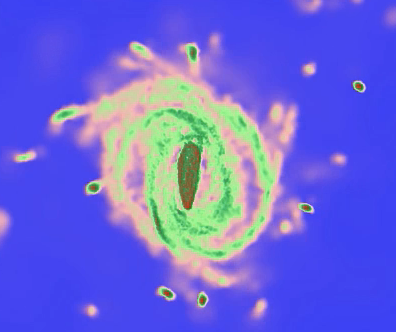
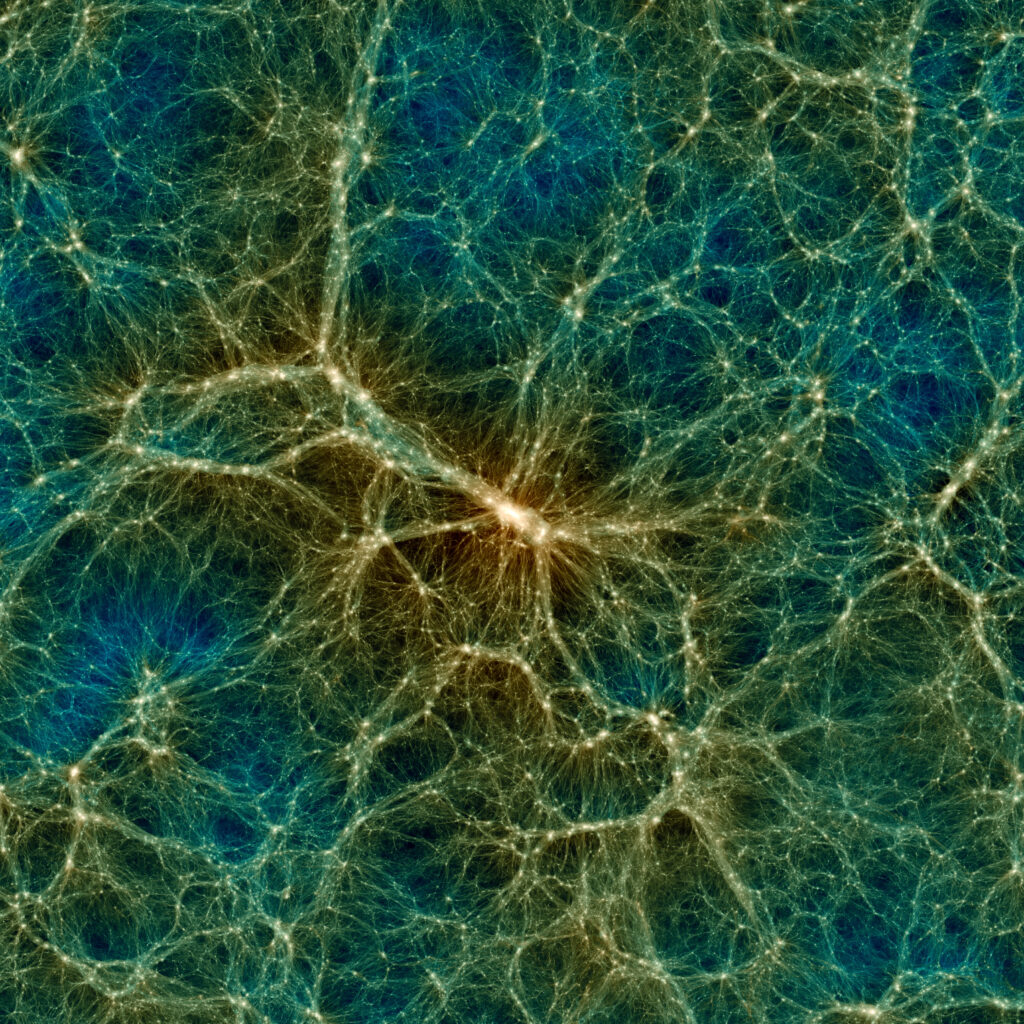
According to the theory of hierarchical structure formation, small structures are formed first in the Universe, which gradually accumulate gravitationally to form galaxies and galaxy clusters. Eventually, a huge bubble-like structure called the large-scale structure of the universe is formed.
The cosmic large-scale structure contains a great deal of important information that can help us understand the evolutionary process of the Universe. For example, the strength of the clustering of galaxies contains information about the accelerated expansion of the Universe, and the geometry of the Universe can be determined from the peak positions of baryon acoustic oscillations(BAO) in the clustering signal. Furthermore, the anisotropy of the clustering can provide insight into the theory of gravity.
Gravity plays a dominant role in the evolution of the large-scale structure of the Universe, and about 85% of the gravitationally active constituents in the universe are dark matter, a mysterious material that cannot be observed with light. The gravitational lensing effect allows us to indirectly observe dark matter, which cannot be observed directly.
We have been analyzing the gravitational lensing effect using survey data from the Hyper Suprime-Cam (HSC) on the Subaru Telescope. Our results, along with those of the U.S.-led Dark Energy Survey (DES) and the European-led KiDS survey, have provided constraints on cosmological models. In the next stage, we will use this experience to further refine and validate our cosmological model, in collaboration with the Vera Rubin Observatory’s LSST and space telescope missions such as Nancy Grace Roman and Euclid.
We will work primarily with the University of Arizona and CCA to develop various levels of analysis pipelines and methods.
Instrumentation
Production/assembly of ELT MORFEO mirror:
MORFEO is an Adaptive Optics (AO) system designed for the Extremely Large Telescope, currently under construction by the European Southern Observatory (ESO) in Chile. By correcting the stellar image distortions caused by atmospheric turbulence in real time, AO enables ground-based telescopes to achieve their full optical performance and incredibly sharp images. By working with the near-infrared camera and spectrograph MICADO, MORFEO will unveil the structures of distant objects with much higher resolution than that of space telescopes. In this project, we are responsible for the fabrication of the large mirrors and lenses for MORFEO. The high-precision metrology and manufacturing techniques used in this development are essential core technologies applicable for next-generation instrumentation including the Thirty Meter Telescope.

ULTIMATE WFI Mid-band filter production:
ULTIMATE WFI is the next generation wide-field near-infrared imager for the Subaru Telescope. By utilizing Ground Layer Adaptive Optics (GLAO), it will achieve a wide-field view with image sharpness twice as high as the natural seeing at Maunakea, one of the world’s premier observing sites. Our contribution to WFI is the development of nine medium-band optical filters that divide the near-infrared range (1–2.5 μm). By transmitting only specific wavelength, these filters enable the precise detection of objects at specific redshifts. The synergy of a wide field of view, high resolution, and wavelength filtering allows us to observe the universe with exceptionally high efficiency. Through a comprehensive survey of galaxies and clusters during the cosmic noon, we aim to achieve a unified understanding of how galaxies acquired their stellar mass and evolved into their present morphologies.

Production of HSC intermediate band filters:
The HSC camera installed on the prime focus of the Subaru Telescope can be equipped with a number of optical filters. HSC is originally equipped with five broadband filters (g, r, i, z, and Y), and a variety of narrow-band filters are also available. We will produce a group of optical filters (intermediate band filters) that continuously and relatively high-resolutionly split the visible wavelength range from 400 nm to 1000 nm. These filters play a very important role in accurately estimating the redshift of galaxies, which is essential for the observation of gravitational lensing effects.
In addition, it can provide important data for various galaxy physics and cosmology, such as the precise selection of Lyman break galaxies and the correlation of statistical shapes of galaxies (intrinsic alignment).
